|
With all of the upheaval in Ukraine coming to a head recently, when friends and family hear that our next climbing trip is to Southern Russia, we are invariably asked if we are going to cancel our trip. The answer for me, at this time, is no - while I will continue to monitor the situation, I believe our itinerary doesn't present any undue risks to our personal safety.
I am not what most people consider a thrill-seeker or a person who "lives on the edge". I do enjoy getting outside of my comfort zone to experience new places, people and challenges, but carefully think out what the risk is to myself and my family before embarking on such an adventure. Believe it or not, climbing has actually taught me to assess risk in any life situation, with the realization that even the smallest decision can have a life-changing impact. One of the first things a climber learns when getting onto the mountain is the difference between objective hazards and subjective hazards. An objective hazard is an aspect of climbing which you largely cannot control, such as bad weather, an avalanche or rock fall, while a subjective hazard is something within a climbers control that can be avoided, such as poor conditioning, dehydration or sloppy footwork. Eliminating subjective hazards should be a straightforward task - generally, training and education can overcome these issues. While this may seem obvious, it is shocking how ill-prepared many climbers are when they tackle a mountain; they often ignore their own inexperience and physical shortcomings to put themselves, and neighbouring climbers, in danger. Adam experienced this first hand on Aconcagua, where he and our guides rescued some climbers who became lost on the trail, and, in another incident, helped climbers who couldn't even put their crampons on properly! Both of these incidents, coupled with the bad weather on the mountain, could have proved fatal had those climbers not received help from our group. Subjective hazards come up frequently on guided climbs, as there is such a large variance in individual climbers fitness and experience. This makes the guide's job very difficult, as he/she has a duty to make sure each climber is safe, while trying to get as many climbers to the summit as possible, at the same time recognizing each individual climber's physical and mental limitations. The situation is very different after identifying an objective hazard - a climbers task is to determine what risks are acceptable and which ones are not. This can often lead to a subjective decision based on a persons risk tolerance and experience. A perfect example was the summit push on Aconcagua - Adam, who was obviously the strongest, most experienced climber in our group, made the decision to try and summit, while the rest of us, who were not nearly as strong, decided to defer to the nasty weather and make our way down the mountain. The guide has the final say, which is why having a competent, experienced, strong willed guide is a must for a safe trip. I use the same objective hazard analysis when traveling in order to decide whether to travel to an area that is seen as unstable. In our case, we are not traveling over or through the Ukraine, where all of the violence has been contained. While some people are worried about the political climate in Russia, hundreds of thousands of people have traveled to the country under much more tense circumstances (the Cold War comes to mind) and reports of travelers and climbers in Moscow and on Elbrus right now are that all is normal. Objective hazards are found around us every day - when we step into a car, drive a motorcycle, or play sports. Being educated on these risks, knowing your limitations, and realizing that living a full life requires some degree of risk are all vital to making the most of our short time here on earth. If the situation in Russia changes, I would have no hesitation pulling the plug and cancelling the trip - at the moment, however, it is all systems go for our departure in 19 days!
1 Comment
|
AuthorsAdam MacDonald, David Banman and their worldwide climbing adventures! 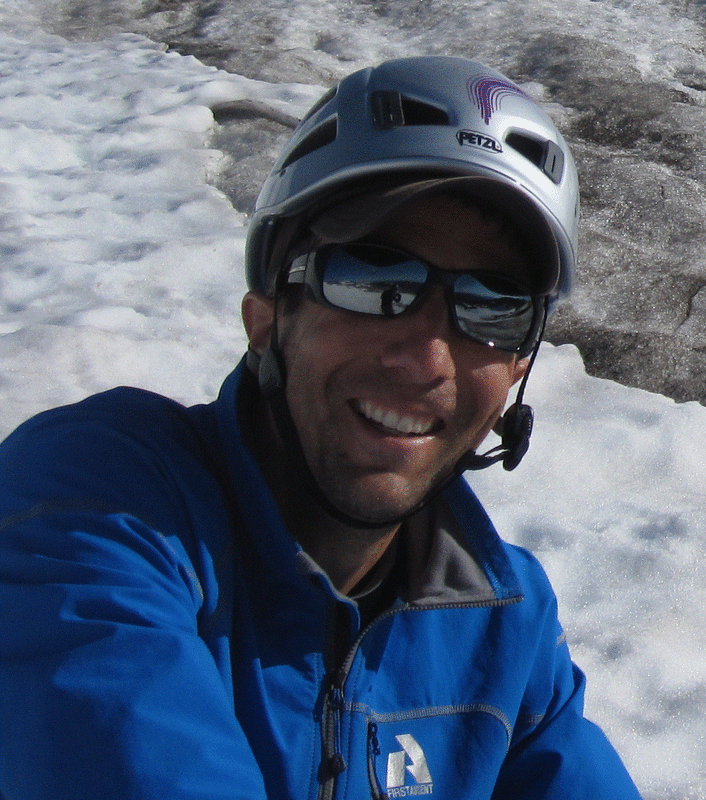
David Banman
Adam MacDonaldArchives
September 2014
Categories |
 RSS Feed